

Spot Greenwashing: 5 Checks for Real Clean Beauty, Why Equity Matters
Clean beauty describes skincare and cosmetics formulated without ingredients commonly linked to health or environmental harm, made with some level of ingredient transparency and ethical sourcing. There is no legal definition behind the term. The FDA does not police it, and groups like the Clean Beauty Coalition push for standards precisely because none exist yet. Your best move as a shopper: trust the ingredient list and the evidence behind it, not the word “clean” printed on the front of the bottle. Brands like Splendoraskincare, that publish full formulas and skip questionable additives, are the ones worth your attention.
TL;DR:
- Trust ingredient transparency and sourcing details over marketing claims of “clean” since there is no official standard.
- Most clean brands exclude ingredients like MI/MCI, formaldehyde, certain parabens, phthalates, synthetic fragrance, and triclosan, but evidence varies for each.
- Consumer vigilance involves checking full ingredient lists, verifying third-party certification, and prioritizing daily-use products with transparent sourcing.
- Safety and exposure risks are uneven, particularly affecting Black women, highlighting the need for stronger regulation and ingredient disclosure laws.
- Supporting brands that publish comprehensive formulas and sourcing practices helps promote credible clean beauty standards and reduces reliance on vague marketing claims.
Table of Contents
- Why “Clean Beauty” Means Different Things to Different Brands
- Which Ingredients Do Clean Brands Usually Avoid?
- How Do You Spot a Greenwashed “Clean” Claim?
- Who Bears the Biggest Burden of Unsafe Beauty Ingredients?
- How Splendoraskincare Applies Clean Beauty Principles
- Applying Clean Beauty Choices Without Overhauling Everything
- Skincare That Fits the Clean Beauty Standard
- Sources
- FAQ
Why “Clean Beauty” Means Different Things to Different Brands
Walk into any store and pick up ten products labeled “clean.” Read the ingredient lists side by side and you will find ten different philosophies. That is not an accident. It is the direct result of a regulatory system that leaves the term almost entirely undefined.
The FDA does not require premarket approval for most cosmetic ingredients, aside from color additives. A company can formulate a moisturizer, put it on shelves, and never submit it for federal review before consumers buy it. Compare that to pharmaceuticals or even food additives, both of which face far more scrutiny before hitting the market. That regulatory gap is exactly where the clean beauty movement took root. Consumers and advocacy organizations built their own hazard lists and vetting systems because no government agency was doing it for them, according to FDA cosmetics guidance.
Retailers stepped into that vacuum too, and each one drew its own lines:
- Some retailers ban entire chemical categories (parabens, phthalates, certain sulfates) from anything sold under their “clean” program.
- Others require third-party lab verification before a product earns a clean label on their shelves.
- Many brands simply self-declare “clean” with no outside review at all.
- A few programs focus narrowly on excluding known allergens rather than broader “toxin” claims.
The result is exactly what you would expect from a market without shared rules: inconsistent labeling, and plenty of room for a marketing team to slap “clean” on a product that would fail a stricter retailer’s checklist. An industry roadmap from EDF+Business argues that “clean” should mean the safest ingredients and lowest environmental impact realistically available today, paired with transparent criteria brands actually publish. That is a meaningfully higher bar than most labels currently meet.
Which Ingredients Do Clean Brands Usually Avoid?
Most clean beauty formulations exclude a fairly consistent shortlist of ingredients, even though no two brands’ lists match exactly. The usual suspects:
- MI/MCI (methylisothiazolinone and methylchloroisothiazolinone), preservatives tied to contact allergies
- Formaldehyde and formaldehyde-releasing preservatives, used to extend shelf life
- Certain parabens, another preservative class under long-running scrutiny
- Phthalates, often hidden inside “fragrance” on an ingredient list
- Synthetic fragrance blends, which can contain dozens of undisclosed compounds
- Triclosan, an antibacterial agent phased out of many formulas
- Some sulfates, mainly for skin and eye irritation concerns rather than systemic risk
The evidence behind these exclusions is not uniform, and pretending otherwise does readers a disservice. Harvard Health points out that MI/MCI, fragrance mixes, and formaldehyde are established, well-documented causes of contact dermatitis. The American Contact Dermatitis Society has named ingredients from this group “Allergen of the Year” multiple times. Formaldehyde itself carries a cancer link at high doses, according to the National Cancer Institute’s research summarized by Harvard Health.
The evidence gap: Contact allergy risk from ingredients like MI/MCI is well established and consistently documented. Low-dose endocrine disruption risk from other commonly avoided ingredients remains scientifically mixed, with far less consensus.
That distinction matters when you are reading marketing copy. “Linked to hormone disruption” and “known to cause allergic reactions in a documented percentage of users” are not the same strength of claim, even though clean beauty marketing often treats them interchangeably.
One more nuance worth holding onto: natural does not automatically mean gentler, and synthetic does not automatically mean riskier. Poison ivy is natural. Plenty of lab-made preservatives are mild and well-tolerated. Safety depends on the specific molecule, the concentration, and how your skin reacts to it, not on whether it came from a plant or a beaker.
How Do You Spot a Greenwashed “Clean” Claim?
A product earns real credibility through transparency, not through the word “clean” on its label. Here is a practical sequence for checking any product before it goes in your cart:
- Read the full ingredient list (INCI). A brand confident in its formula publishes every ingredient by name, not a vague “proprietary blend.”
- Look for disclosed fragrance components. If “fragrance” or “parfum” appears with no further detail, ask why. Some brands now publish which compounds make up their scent, a practice worth rewarding with your purchase.
- Check for third-party certification or independent testing, rather than a brand’s own internal “clean” seal with no outside verification.
- Search for a sourcing summary. Where do the plant extracts, oils, or minerals come from, and does the brand say so plainly?
- Prioritize daily-use products first. A cleanser or moisturizer you apply every day matters more than an occasional-use item, so start your ingredient audit there.
Good transparency looks like a full INCI list next to a plain-language explanation of what each major ingredient does, plus a sourcing note that names actual regions or suppliers rather than saying “responsibly sourced” with no specifics. The FTC’s Green Guides exist specifically to curb misleading environmental and “green” marketing claims, giving you some legal backing when a brand’s language stretches past what it can support.
Pro Tip: Bookmark a product’s ingredient list before you buy, not after. Brands occasionally reformulate without much fanfare, and the bottle you loved last year may not match what ships to you today.
Who Bears the Biggest Burden of Unsafe Beauty Ingredients?
Clean beauty is not only a personal health question. It is a health equity question, and the data on that point is stark.
Research cited by the Clean Beauty Coalition found that Black women may be exposed to significantly more toxic beauty ingredients than white women, and a portion of products marketed specifically to Black women rank as highly hazardous.
That gap did not happen by chance. Products marketed toward Black women, including relaxers, skin lighteners, and certain hair care lines, have historically contained higher concentrations of ingredients like parabens and phthalates than products marketed to broader audiences. Advocacy groups argue that fixing this requires more than individual purchasing choices. It requires ingredient disclosure laws, retailer accountability, and policy reform that changes what is allowed on shelves in the first place, not just what wealthier or better-informed shoppers manage to avoid.
On the policy side, momentum has been building. Legislative efforts around cosmetics safety, including congressional advocacy tied to the Safer Beauty Bill Package, push for stronger federal oversight than the current system provides. Retailer-led standards are filling gaps faster than federal rulemaking, but advocates are clear that retailer vetting is a stopgap, not a substitute for enforceable regulation.
What can you actually do with this information? Buy from brands that publish their sourcing and testing practices. Support advocacy organizations pushing for ingredient transparency laws. And if a product marketed to a specific community carries red-flag ingredients other product lines have already phased out, say something to the retailer selling it. Individual vigilance and systemic pressure work together here, not as alternatives to each other.
How Splendoraskincare Applies Clean Beauty Principles
The brand builds every formula around a short list of non-negotiables: cruelty-free, vegan, gluten-free, and free from artificial additives. That is not a marketing tagline bolted on after the fact. It shapes which raw ingredients make it into a product and which ones get rejected before formulation even starts.
The brand’s approach shows up clearly in two products built for daily use:
- The SKINCARE 5-STEP ROUTINE pairs a cleanser, toner, serum, eye cream, and moisturizer into one sequence, so you are not guessing which five separate products actually work together.
- The Golden Moisturizing Cleanser cleanses, brightens, and hydrates in a single step, using hand-harvested ingredients rather than a long list of synthetic fillers.
… Consistency matters more than any single ingredient swap. A simple routine you actually follow every day tends to outperform a complicated one you abandon after two weeks, which is the entire logic behind building a five-step system instead of a fifteen-product regimen…
If you are rethinking your own routine from the ground up, a complete skincare guide walks through how to sequence products and which ingredients to prioritize first.
Applying Clean Beauty Choices Without Overhauling Everything
You do not need to throw out every product under your sink to take clean beauty seriously. Start with what touches your skin daily. A cleanser, a moisturizer, and sunscreen matter more than the eyeshadow palette you wear twice a month, simply because of exposure frequency. Fix the daily items first and let the occasional-use products wait.
New product, new risk, however “clean” the label claims to be. Patch-test on your inner forearm for 24 to 48 hours before putting anything new on your face, especially if you have reactive or sensitive skin. If you deal with eczema, rosacea, or another diagnosed skin condition, fragrance-free formulas are usually the safer default, and a dermatologist should weigh in before you chase any trend, clean-labeled or otherwise.
Keep your skepticism balanced. Not every synthetic ingredient deserves suspicion, and not everything “natural” deserves a pass either, as the contact allergy data on preservatives makes clear. The honest version of clean beauty is not extremism in either direction. It is asking brands to show their work, and rewarding the ones that actually do.
— Cyril
Skincare That Fits the Clean Beauty Standard
This brand provides an alternative to guessing whether a “clean” label holds up, offering transparency on cruelty-free, vegan, gluten-free formulas built without artificial additives, using hand-harvested ingredients you can trace back to their source.
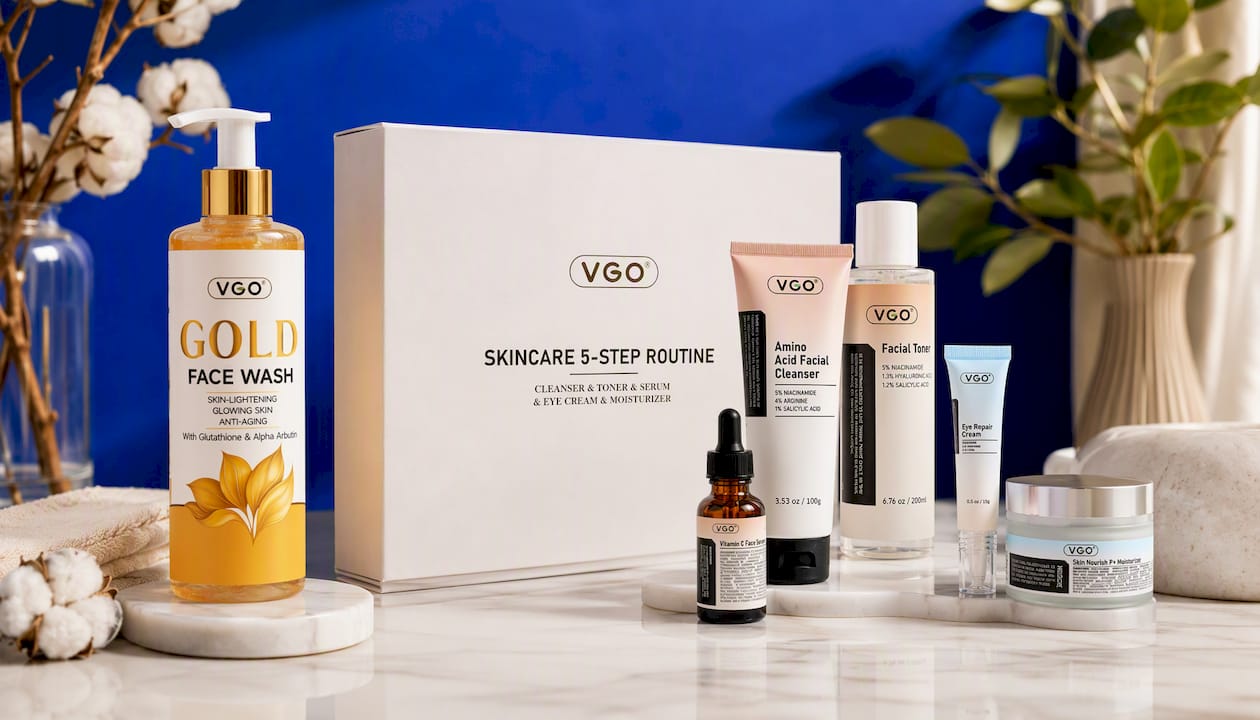
The SKINCARE 5-STEP ROUTINE gives you a cleanser, toner, serum, eye cream, and moisturizer designed to work as a sequence rather than five separate impulse buys. If you would rather start smaller, the Golden Moisturizing Cleanser handles cleansing, brightening, and hydration in one product, without the long list of fillers you would need a chemistry degree to decode. Readers with reactive or delicate skin can also look at the facial moisturizing lotion for delicate skin built specifically for that concern.
Start with one product if a full routine feels like too much at once. Check the ingredient list on the Golden Moisturizing Cleanser product page and see for yourself whether it matches the transparency standard this article just walked you through.
Sources
- Clean Beauty Coalition — What is clean beauty?
- Clean cosmetics: the science behind the trend | Harvard Health
- Cosmetics — U.S. law | FDA
FAQ
What Does Clean Beauty Really Mean?
It generally means a product avoids ingredients linked to health or environmental harm and comes with some level of transparency about sourcing and formulation, but no legal or industry-wide standard defines the term, according to Healthline.
What Is the Difference Between Clean Beauty and Regular Beauty?
Regular beauty products face the same limited FDA premarket oversight as clean products; the difference lies in which ingredients a brand chooses to exclude and how much it discloses, not in any separate regulatory category.
What Does Sephora’s Clean Beauty Label Mean?
Retailer-specific clean programs like Sephora’s set their own excluded-ingredient lists, meaning a product’s “clean” status can change depending on which store’s criteria it was measured against, since no universal standard exists across retailers.
What Is the Clean Beauty Trend Really About?
Beyond individual product swaps, the trend reflects growing demand for ingredient transparency and accountability, fueled partly by health equity research showing uneven exposure to hazardous ingredients across different consumer groups.
Is Natural Always Better Than Synthetic in Clean Beauty?
No. Safety depends on the specific ingredient and how much of it you’re exposed to, not whether it originated in a lab or a plant; some natural compounds cause more irritation than their synthetic counterparts.