

3 Products: Simple Skincare for Men You Can Copy Paste
For most men, an effective routine comes down to three steps: cleanse, moisturize, and apply broad-spectrum SPF every morning, with an optional second cleanse and moisturizer at night. Dermatologists call this the cleanse, moisturize, protect framework, and it works precisely because there’s nothing to forget. A curated starter routine can cover all three roles in one purchase, and adding a weekly exfoliation or a low-dose retinol later is optional, not required.
TL;DR:
- Using a single, broad-spectrum SPF 30+ sunscreen daily is the most effective habit for anti-aging and skin cancer prevention, regardless of weather.
- In the morning, hydration should be layered on damp skin, starting with a serum or lightweight moisturizer, followed by sunscreen reapplication when outdoors.
- Night routines should focus on cleansing and applying a richer moisturizer, with the option to introduce retinol or exfoliant two nights a week, never both at once.
- Patch testing new active products is crucial to avoid allergic reactions, especially when introducing retinol, salicylic acid, or Vitamin C serums.
- Most men use twice as much product as needed, and keeping skincare products away from heat and light extends their effectiveness and reduces waste.
Table of Contents
- What Does a Simple Morning Skincare Routine Look Like?
- How Should Your Night Routine Differ From Morning?
- How Do You Choose One Product for Each Step?
- Quick 3-Step Routines by Skin Type
- Common Mistakes and What Actually Builds Better Skin
- Where Does Application Order Actually Matter?
- Why Patch Testing Matters Before Committing to a New Product
- How Do You Avoid Wasting Product and Overspending?
- Why Minimal Routines Match How We Build Products
- Start With One Kit Instead of Five Products
- Where to Read More on Simple Skincare for Men
- Sources
What Does a Simple Morning Skincare Routine Look Like?
Three minutes, three products, done. Start with lukewarm water on your face for 30 to 60 seconds. Skip the cleanser most mornings if your skin isn’t oily or you didn’t sweat overnight. Water alone rinses away the light oil buildup from sleep, and hot water strips your skin’s protective lipid layer, which leaves you drier, not cleaner.
Next comes hydration, applied while your skin is still slightly damp so the product locks in moisture instead of evaporating off dry skin. Layer light to heavy: a hydrating serum first if you use one, then your moisturizer.
Sunscreen goes on last, every single day, rain or shine, and it’s the step men skip most. That’s a mistake, because daily broad-spectrum SPF 30+ is the single most effective anti-aging and skin-cancer-prevention habit you can build into a routine this short.
Pro Tip: Use enough sunscreen to cover your face fully, and reapply frequently if you’re outdoors or sweating. If you have a beard, work sunscreen into the skin underneath, not just on top of the hair.
The morning sequence in order:
- Rinse or cleanse with lukewarm water
- Apply hydrating serum or lightweight moisturizer to damp skin
- Finish with broad-spectrum SPF 30+, reapplied outdoors
How Should Your Night Routine Differ From Morning?
Evening is when you actually clean off the day, not add more protection. One gentle cleanse is enough for most men. Double-cleanse only if you wore heavy sunscreen, sweated through a workout, or your skin feels genuinely grimy by nightfall.
After cleansing, apply a richer night moisturizer to damp skin, especially if your skin runs dry or you live somewhere cold and windy. This is also where you introduce the one treatment step that separates a basic routine from a slightly more advanced one: retinol or a mild exfoliant, never both on the same night.
- Pick one active ingredient to add, not several.
- Start retinol at two nights a week, no more, since it increases sun sensitivity and needs consistent SPF the next morning.
- Wait 2 to 4 weeks before judging results or adding anything else.
- If you notice redness, flaking, or tightness, cut back to once a week and lean on your moisturizer until skin calms down.
- Never stack a strong exfoliant and retinol in the same routine. It’s one or the other.
Retinol works best when introduced slowly, and irritation almost always means you moved too fast, not that the product doesn’t work for you.
How Do You Choose One Product for Each Step?
You don’t need five options for every step. You need one that fits your skin and doesn’t fight against it. Check the label for three things: non-comedogenic (won’t clog pores), fragrance-free (not just “unscented,” since unscented products often contain masking fragrances that irritate sensitive skin anyway), and SPF 30 or higher with broad-spectrum coverage on your sunscreen.
Texture tells you a lot before you even read the ingredient list:
- Gel formulas suit oily skin
- Lotions work for normal or combination skin
- Creams suit dry skin
A hydrating serum with hyaluronic acid can replace a lightweight moisturizer entirely on humid days or for men with normal to oily skin who find creams too heavy. Splendoraskincare’s Smooth Skin Serum fits this role, while the Facial Skin Moisturizing Lotion Delicate Skin works better for drier or sensitive skin that needs more cushion. Vitamin C is worth adding in the morning under sunscreen if you want an antioxidant boost, but it’s an extra, not a requirement.
Pro Tip: If a bottle lists both “unscented” and a long fragrance-related ingredient name buried in the list, treat it as scented for irritation purposes.
Quick 3-Step Routines by Skin Type
Skin type determines texture and strength, not the number of steps. Here’s the shortcut version for each:
- Oily skin: Foaming cleanser morning and night, lightweight gel moisturizer, mattifying SPF 30+ in the morning.
- Dry skin: Hydrating cream cleanser or gentle balm, a richer night cream, and a moisturizing sunscreen (or moisturizer layered under a lighter SPF) in the morning.
- Sensitive skin: Fragrance-free products across the board, no strong chemical exfoliants, and every new product introduced one at a time over several weeks.
- Acne-prone skin: A salicylic acid cleanser or a targeted spot treatment in the morning, a non-comedogenic moisturizer, and a dermatologist visit if breakouts stay moderate to severe despite a consistent routine.
None of these need a fourth or fifth product bolted on. The formula stays the same across skin types. Only the texture and active ingredients change.
Common Mistakes and What Actually Builds Better Skin
The biggest mistake is speed: buying five new products and using all of them starting Monday. When something irritates your skin three days later, you have no idea which one caused it. Introducing one new product every 2 to 4 weeks lets you actually see what’s working before you add the next thing.
Hot water in the shower feels good and does real damage to your skin’s barrier over time. Skipping sunscreen because it’s cloudy is another common one, and UV damage doesn’t care about clouds.
Consistency, not product count, is what moves the needle. A short routine followed daily for a month beats a long one abandoned after a week.
A few habits worth building alongside the routine itself:
- Wash pillowcases weekly. Oil and product residue build up faster than most men expect.
- Shave after cleansing, not before, so skin is softer and less prone to irritation.
- Sleep and hydration affect skin recovery just as much as any product you apply.
Where Does Application Order Actually Matter?
Order matters because product texture and molecule size determine how well each layer absorbs. Apply thinnest, most water-based products first and thickest, most occlusive products last. A watery serum applied after a heavy cream just sits on top and never penetrates.
The general rule: cleanser, then toner or essence if you use one, then serum, then moisturizer, then sunscreen in the morning. At night, drop the sunscreen and add your treatment (retinol or exfoliant) either right after cleansing on bare skin or after moisturizer, depending on the product’s instructions. Retinol typically goes on clean, dry skin before moisturizer, since moisturizer buffers its strength slightly and reduces irritation for beginners.
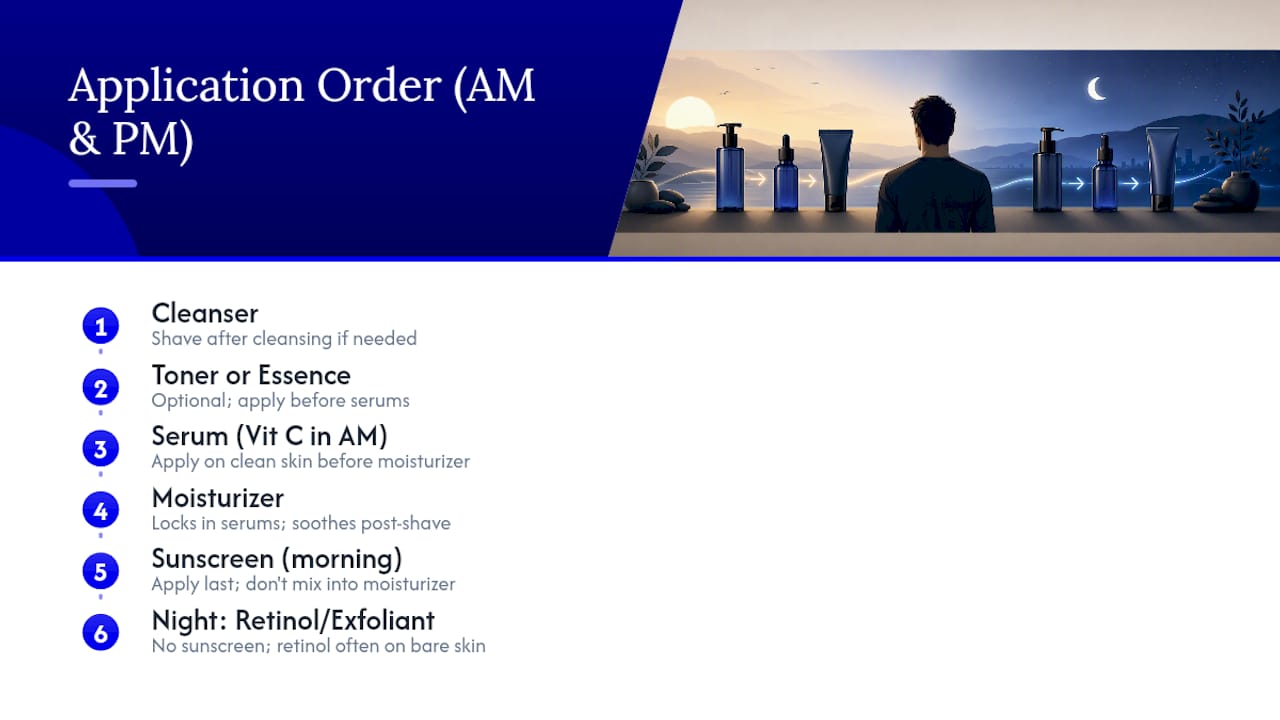
If you shave, that changes the order too. Shave after your cleanser but before serum or moisturizer, since shaving itself acts as a mild exfoliation step and leaves skin more receptive to what comes next. Post-shave, skip anything with alcohol or strong actives for at least a few hours. A plain, fragrance-free moisturizer calms freshly shaved skin better than a treatment product will.
One more detail men miss: sunscreen goes on last, over everything, never mixed into or under moisturizer. Mixing dilutes the SPF concentration and reduces the protection you’re actually getting. If you use a vitamin C serum in the morning, it goes on clean skin before moisturizer, since antioxidants work best absorbed directly rather than layered under something else first.
Why Patch Testing Matters Before Committing to a New Product
Skip patch testing and you’re running an experiment on your entire face with no control group. Apply a small amount of any new product to your inner forearm or behind your ear, then wait 24 to 48 hours before using it on your face. This catches allergic reactions and irritation before they show up somewhere visible.
This matters more with active ingredients than with a basic moisturizer. Retinol, salicylic acid, and vitamin C serums are far more likely to cause redness or peeling in the first few uses than a simple fragrance-free lotion. If a patch test comes back irritated, you’ve saved yourself weeks of guessing why your face looks inflamed.
It also matters if you’re switching brands entirely, not just adding a new category of product. A moisturizer that worked fine for years can still cause a reaction if the manufacturer changes its formula, so a quick patch test after any reformulation is worth the extra day. Men with a history of sensitive skin, eczema, or rosacea should treat patch testing as mandatory, not optional, since flare-ups from a new active can take days to calm down once triggered.
The other benefit is practical: patch testing lets you rule out a specific product when something goes wrong, rather than tearing your entire routine apart. If you’ve introduced one new product every few weeks like the routine above recommends, and you patch tested each one, tracing a reaction back to its source takes minutes instead of guesswork.
How Do You Avoid Wasting Product and Overspending?
Most men use two to three times more product than they need per application. A pea-sized amount of cleanser and a similar amount of moisturizer covers the entire face. Squeezing out a palmful just means half of it sits unused on the sink or gets rinsed away.

Storage affects waste too. Keep products away from direct sunlight and steamy bathroom heat, both of which degrade active ingredients like vitamin C and retinol faster than the expiration date suggests. A drawer or cabinet outside the shower keeps formulas stable longer.
Buying fewer, better products also cuts waste at the source. A single well-chosen moisturizer that handles hydration without needing a separate night cream means one bottle empties before it expires, instead of three half-used tubes cluttering your shelf. This is the practical case for a minimal routine beyond the time savings: less product open at once means less product that goes bad before you finish it.
Skip the multi-step kits with ingredients that overlap or actively conflict, since you’ll end up using maybe half of what you bought. If a serum and moisturizer both claim to hydrate, you likely need one or the other, not both every day.
Why Minimal Routines Match How We Build Products
Most men don’t want a nine-step routine. They want something that works, doesn’t take twenty minutes, and doesn’t require a chemistry degree to understand the label. Products made with cruelty-free, vegan, and clean, hand-harvested ingredients show that simplicity and effectiveness aren’t opposites.
A short routine only works if each product pulls real weight, which is why we’d rather ship one serum that does its job than five that overlap. If you want the low-decision version of everything covered above, the 5-step routine kit maps directly onto it.
— Cyril
Start With One Kit Instead of Five Products
Splendoraskincare’s 5-step routine kit skips the guesswork of matching separate brands to each step, since every product in it is formulated to work together from the start.

The cleanser, toner, serum, and moisturizer inside the kit cover exactly the steps outlined above, so there’s no separate hunt for a compatible moisturizer or a serum that plays well with whatever else you’re using. If you already have a cleanser you like and just need one piece, the Facial Skin Moisturizing Lotion Delicate Skin works well for dry or reactive skin on its own, and the Smooth Skin Serum is a solid standalone pick if you want hydration without the added weight of a heavier cream. Formulas are typically cruelty-free, vegan, and free of artificial additives, so patch testing one new product is a recommended step before adding it to your routine. Pick the full kit if you’re starting from scratch, or grab a single product to slot into what you’re already doing, and check the product page for current availability.
Where to Read More on Simple Skincare for Men
A few outlets consistently back up the framework this article follows, if you want to dig deeper on any single point:
- Cleveland Clinic covers the dermatologist-backed cleanse, moisturize, protect approach in more clinical detail.
- Healthline breaks down the three-product routine and sunscreen application specifics.
- Allure explains the pacing behind introducing new products safely.
- Esquire offers an expert-designed take on when to add extras like retinol.
- NexGen Clinic provides a clinic-backed breakdown of the same three-step approach from a dermatology practice.
Sources
- The Best Simple Skincare Routine with 3 Products
- Skin Care for Men: Routines, Products and Tips
- Beginner’s guide to skin care