

Skip Fragrance in Leave On Treatments: Research Backed Skincare Rules
Fragrance is not inherently harmful for most people, but if you have a confirmed fragrance allergy, eczema, rosacea, or a compromised skin barrier, avoiding it is the safer default. Everyone else can generally tolerate scented products, though leave-on treatments deserve more caution than rinse-off ones. The smartest move for anyone trying a new scented product: patch test first, and lean fragrance-free for anything that stays on your skin for hours.
TL;DR:
- Fragrance can cause contact dermatitis and should be avoided by individuals with eczema, rosacea, or confirmed fragrance allergies, especially in leave-on products.
- Low concentrations of fragrance do not eliminate the risk of skin sensitization, as even trace levels can trigger reactions in susceptible skin.
- Natural oils are not inherently safer than synthetics; both can contain sensitizing compounds like linalool and limonene.
- Patch testing new scented products on the inner forearm for three days can help identify possible reactions before facial use.
- Labeling regulations allow fragrance to be listed as a single ingredient, masking the presence of dozens of compounds, so thorough ingredient analysis is essential for allergy management.
Table of Contents
- What “Fragrance” Actually Means and Why Brands Add It
- Who Actually Needs to Worry About Fragrance
- What the Research Actually Shows About Harm and Benefit
- How to Read a Label and Spot Hidden Fragrance
- Choosing Fragranced vs. Fragrance-Free in Real Life
- How Splendoraskincare Approaches Scent Across Its Products
- Synthetic vs. Natural Aromatic Compounds
- Regulatory Standards Governing Fragrance in Skincare
- Fragrance and Your Skin Microbiome Over Time
- Sensory Alternatives That Skip Fragrance Entirely
- What the Evidence Really Tells You to Do
- Fragrance-Aware Picks If You’re Still Deciding
- Sources
- FAQ
What “Fragrance” Actually Means and Why Brands Add It
“Fragrance” and “parfum” are catch-all label terms for a mixture of aromatic compounds, sometimes dozens of them, blended into a single ingredient line. Essential oils are different: they’re named individually because they’re extracted from a specific plant rather than engineered as a proprietary blend. Both can trigger the same reactions in sensitive skin.
Brands add scent for reasons that go beyond making a product smell nice.
- Masking the natural odor of raw materials like plant oils, preservatives, or surfactants, which often smell unpleasant on their own
- Building a recognizable brand signature that customers associate with quality
- Encouraging a sensory ritual that makes people more likely to stick with a routine, since added odor tends to increase product liking and reported well-being
Most fragrance sits at a low concentration in the finished product. A low percentage does not mean zero risk. Sensitization can still happen in susceptible skin even at trace levels, which is why concentration alone isn’t a reliable safety signal.
Who Actually Needs to Worry About Fragrance
Fragrance is one of the most common triggers of contact dermatitis, especially in people who already have compromised or reactive skin. That’s not a fringe concern. Clinical guidance consistently points to fragrance as a leading cause of contact dermatitis in sensitive populations, which is why dermatologists treat it differently than most other cosmetic ingredients.
There are two distinct reactions worth telling apart:
- Irritant contact dermatitis shows up as burning, stinging, or redness shortly after application, often from a single exposure, and doesn’t require prior sensitization.
- Allergic contact dermatitis develops after your immune system learns to react to a specific fragrance compound, sometimes after years of trouble-free use, and typically appears as itching, rash, or swelling that can worsen with repeated exposure.
The practical fallout is straightforward. If you have eczema, rosacea, or a diagnosed fragrance allergy, fragrance-free products should be your default, not an occasional swap. If you suspect a fragrance allergy but haven’t confirmed it, a dermatologist can run patch testing to identify the specific compound responsible, which matters more than most people realize since “fragrance” covers so many different chemicals.
Pro Tip: If a product burns on first contact, that’s usually irritation, not allergy. But if a rash builds over 24 to 48 hours after repeated use, treat that as a signal worth getting checked.
What the Research Actually Shows About Harm and Benefit
The harm side of the ledger is well established. Fragrance mixtures are a recurring, well-documented cause of allergic and irritant reactions, and that risk concentrates heavily in people with existing skin barrier issues. This isn’t a fringe finding buried in a single study. It’s consistent clinical guidance built on decades of patch-test data.
The benefit side is newer and more limited, but genuinely interesting. A 2025 study using EEG monitoring tested a neuromodulatory fragrance called PD53, worn nightly for four weeks by 30 healthy adults.
Participants using the fragrance showed improved sleep quality alongside small but statistically significant improvements in skin elasticity and reduced transepidermal water loss, compared with an unscented control group.
The theory is that certain fragrances can influence brain activity in ways that improve sleep, and better sleep shows up indirectly in skin function. It’s a compelling mechanism, but 30 people over four weeks is a small, short study. It suggests a real signal worth further research, not a settled fact about what fragrance does for skin.
Put those two bodies of evidence side by side and a clear picture emerges. The harm evidence is broad, replicated, and clinically actionable. The benefit evidence is early, narrow, and specific to one formulated fragrance tested under lab conditions. Treat them with correspondingly different confidence.
How to Read a Label and Spot Hidden Fragrance
The FDA permits fragrance formulas to be listed as a single ingredient called “fragrance” or “parfum” because the exact blend is considered a trade secret. That single line can represent dozens of individual compounds, and none of them have to be disclosed by name.
This creates two common points of confusion worth clearing up.
- “Unscented” doesn’t mean fragrance-free. It usually means a masking fragrance was added specifically to cancel out other odors, so the product doesn’t smell like anything.
- “Fragrance-free” means no fragrance ingredients were added at all, including masking agents.
- Sensitizers like linalool and limonene appear frequently in patch-test-positive cases and are worth scanning for on ingredient lists if you’ve reacted before.
- If a company’s label doesn’t give you enough detail to judge your risk, contacting the manufacturer directly for a full ingredient disclosure is a reasonable ask.
Choosing Fragranced vs. Fragrance-Free in Real Life
Rinse-off products like cleansers carry lower risk for most people since contact time is short. Leave-on actives, serums, moisturizers, anything that sits on your skin for hours, deserve more scrutiny, especially if they contain retinoids, acids, or other actives that already stress the skin barrier.
- Patch test any new scented product on your inner forearm for three consecutive days before using it on your face.
- Watch for burning, itching, or redness in that window; a clean pass doesn’t guarantee zero risk, but it filters out the most common reactions.
- Continue watching over 7 to 10 days once you move to facial use, since some reactions build slowly rather than appearing immediately.
- Avoid introducing any new fragranced product during a flare, right after a microneedling session, or while using retinoids or chemical peels, when your barrier is already compromised.
Fragrance exposure also adds up across your day. Shampoo, laundry detergent, and even a partner’s cologne all contribute to cumulative exposure that can trigger late-onset sensitivities, so a single product swap won’t always solve a mystery reaction.
Pro Tip: If you’ve used a scented product for years without issue and suddenly react, don’t assume the formula changed. Barrier-disrupting events like sunburn or a new retinoid often cause fragrance sensitivity to surface out of nowhere.
How Splendoraskincare Approaches Scent Across Its Products
Splendoraskincare builds its range around clean, cruelty-free, vegan formulas, and that philosophy extends directly to fragrance decisions. Leave-on treatments and serums are formulated to stay fragrance-free or minimally scented, since those are the products spending the most time on your skin. Cleansers and body-care items have more room for a light sensorial note, since rinse-off contact time is shorter and the ritual benefit matters more there. That distinction mirrors what dermatologists generally recommend: save fragrance for rinse-off steps, and keep active treatments clean.
Synthetic vs. Natural Aromatic Compounds
Fragrance ingredients fall into two broad chemical families, and neither is automatically safer than the other. Synthetic aromatics are manufactured in a lab to replicate or extend a natural scent, often chosen because they’re more stable, consistent from batch to batch, and cheaper to produce at scale. Natural aromatic compounds come from plant sources: essential oils, absolutes, and resins extracted through distillation or cold pressing.
Here’s the part that surprises a lot of people: natural doesn’t mean gentler. Essential oils like lavender, tea tree, and citrus oils are common sensitizers precisely because they contain concentrated amounts of reactive compounds like linalool and limonene, the same chemicals that show up repeatedly in patch-test data for synthetic fragrance blends. A synthetic version of a molecule can actually be more predictable in terms of reaction risk, since manufacturers can control purity and concentration more tightly than nature does.
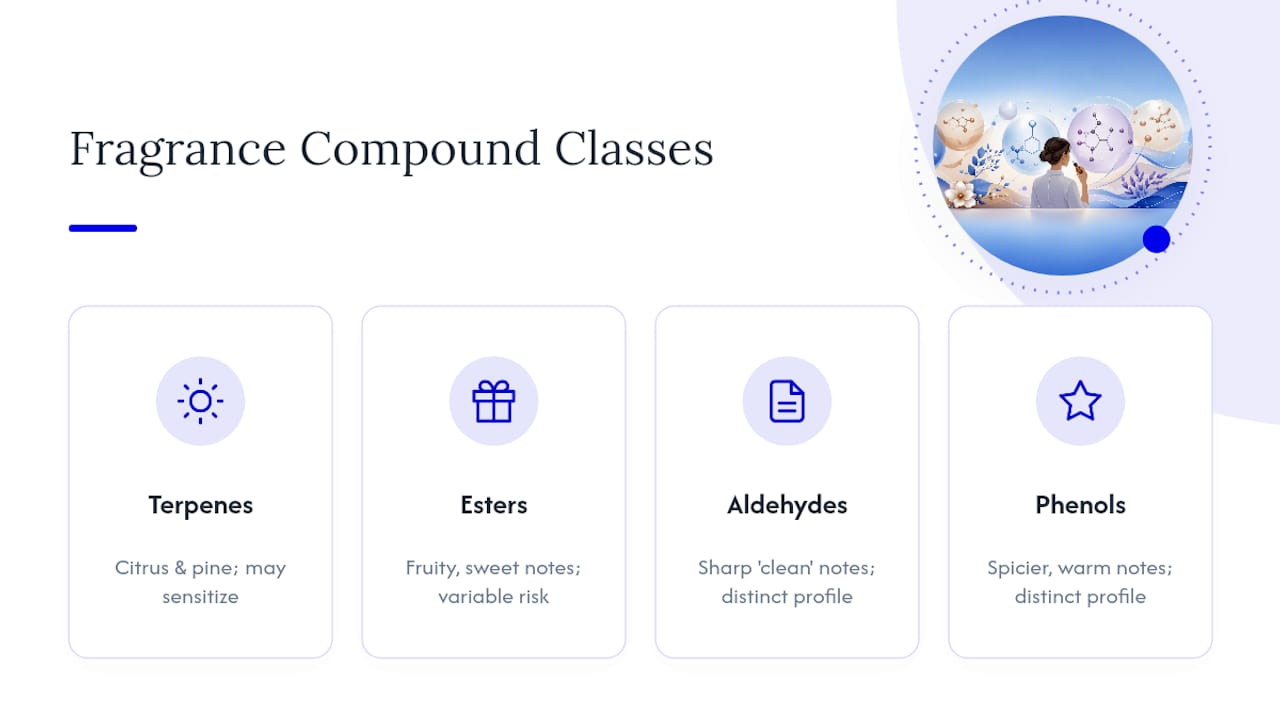
Within these two families, chemists further classify fragrance ingredients by structure: terpenes (common in citrus and pine-derived scents), esters (fruity, sweet notes), aldehydes (used for sharper, “clean laundry” type scents), and phenols (found in spicier, warmer notes). Each class carries a different sensitization profile, which is part of why a person can react to one floral scent and tolerate another without any obvious pattern. If you’ve had a reaction before, the useful question isn’t “was this natural or synthetic,” but “which specific compound was in it.”
Regulatory Standards Governing Fragrance in Skincare
The fragrance industry doesn’t operate without oversight, even though the rules differ from what governs drug ingredients. The International Fragrance Association (IFRA) sets voluntary usage standards that cap or restrict specific fragrance materials based on safety assessments, and most major fragrance suppliers formulate to comply with these limits before a fragrance ever reaches a formulator’s bench.
On the labeling side, the FDA’s rule allowing “fragrance” or “parfum” as a single catch-all ingredient exists because fragrance formulas are treated as trade secrets, not because the ingredients are considered risk-free. That regulatory gap is exactly why label literacy matters more for fragrance than for almost any other cosmetic ingredient category: you can see that a product contains fragrance, but not what’s actually in it.
Regulation also varies by market. Some regions require disclosure of specific known allergens above a certain concentration threshold, even within a fragrance blend, while others rely more heavily on industry self-regulation through bodies like IFRA. If you’re managing a confirmed allergy to a specific compound, checking whether your region requires that allergen to be named separately on the label is worth the five minutes it takes.
Fragrance and Your Skin Microbiome Over Time
Your skin hosts a community of bacteria, fungi, and other microorganisms that help regulate barrier function, hydration, and inflammation. Fragrance compounds interact with that ecosystem, though the science here is younger and less settled than the contact dermatitis research.
The concern isn’t that fragrance wipes out your microbiome overnight. It’s more that repeated low-level irritation from fragrance sensitizers can chip away at barrier integrity over months or years, and a compromised barrier tends to create conditions that favor less balanced microbial communities. This is part of why people with borderline reactive skin sometimes notice their skin becoming more reactive over time when they stick with heavily fragranced routines, even without a single dramatic flare-up.
This is also a case where cumulative exposure matters more than any single product. If your cleanser, moisturizer, body lotion, and laundry detergent all carry fragrance, the combined irritation load on your skin barrier is higher than any one product’s label would suggest. For skin that’s already showing signs of sensitivity, redness, dryness, occasional stinging, a fragrance audit across your whole routine, not just your skincare, is often more useful than swapping one product.
Sensory Alternatives That Skip Fragrance Entirely
You don’t have to give up the pleasant, ritual feel of skincare to avoid fragrance risk. A growing number of formulas lean on texture, temperature, and botanical extracts to create a sensorial experience without added scent compounds.
Cooling gel textures, silky finishes from emollients like squalane, and slow-absorbing creams all contribute to the “this feels good” moment that fragrance is often added to create. Botanical extracts, think chamomile, green tea, or oat, can be included for their skin benefits without being processed into an aromatic fragrance ingredient, so you get the marketing story of a natural product without the sensitization risk that comes with true essential oils.
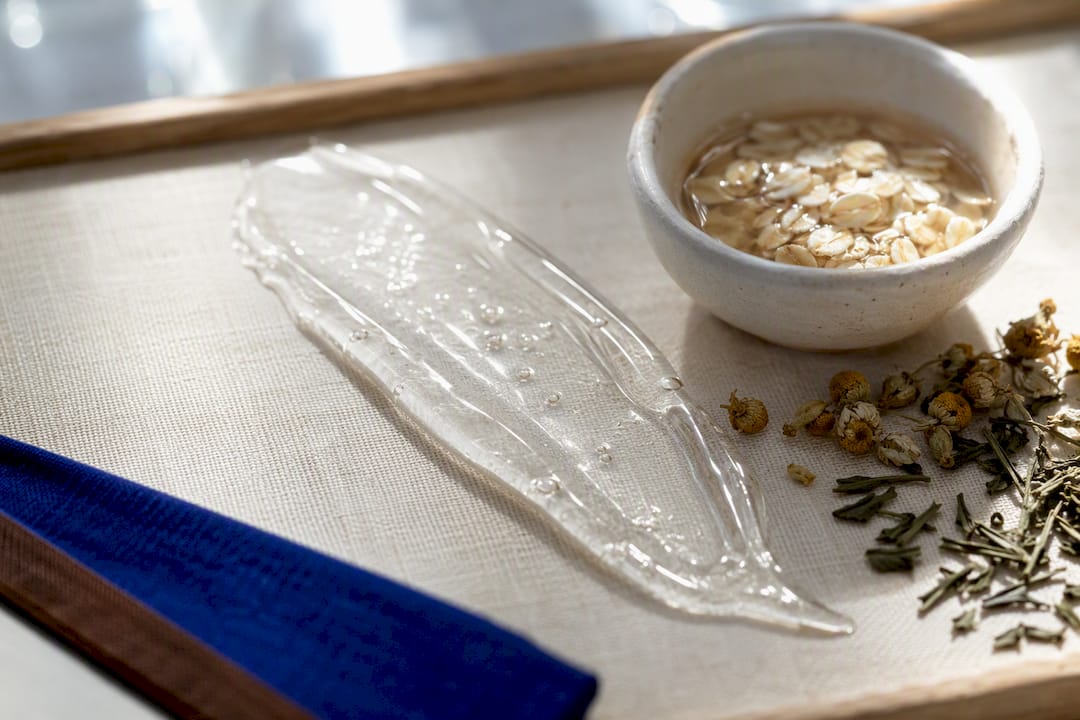
Some brands also use naturally low-odor carrier ingredients, like certain plant butters, that come with a faint, incidental scent rather than a deliberately engineered one. That’s different from a labeled “natural fragrance,” which is still a fragrance ingredient subject to the same disclosure rules and same sensitization risks as a synthetic blend. If the sensory ritual matters to you but reactions are a concern, texture-forward, extract-based formulas are the more reliable route.
What the Evidence Really Tells You to Do
The conventional advice on fragrance in skincare tends to split into two unhelpful camps: “fragrance is fine, don’t overthink it” or “fragrance is toxic, avoid it entirely.” Neither holds up against the actual evidence. The clinical data on contact dermatitis is strong enough that people with eczema, rosacea, or known allergies should treat fragrance-free as a real rule, not a suggestion. But the same data doesn’t support blanket fear for people without those conditions.
What gets underappreciated is how much the product category matters more than the presence of fragrance itself. A scented cleanser you rinse off in thirty seconds carries a fundamentally different risk profile than a scented serum you leave on overnight under a moisturizer. Most fragrance anxiety online treats all scented products as equally risky, and that’s simply not how exposure time or absorption works.
If I had to boil this down to one priority: stop asking “is fragrance bad” and start asking “is this specific product, on this specific part of my routine, worth the risk for me.” That question actually has an answer.
— Cyril
Fragrance-Aware Picks If You’re Still Deciding
If you’re trying to reduce fragrance exposure without giving up results, start with the products that spend the most time on your skin. Splendoraskincare’s organic skin tag removal serum is a targeted, leave-on treatment formulated with clean, hand-harvested ingredients rather than a scent profile designed to mask anything. The anti-aging anti-wrinkle whitening facial serum follows the same logic: it’s a leave-on active, so keeping it fragrance-minimal matters more than it would for a rinse-off step.
For everyday hydration, the facial skin moisturizing lotion for delicate skin is built specifically for reactive or sensitive skin types that need consistent barrier support without added irritation risk. All three products are cruelty-free, vegan, and gluten-free, in keeping with a broader formulation approach.
Before committing to any new product, patch test it and check the full ingredient list yourself, especially if you’ve had a fragrance reaction before. Sampling a product on a small area for a few days costs you nothing but a little patience, and it’s the single best way to know how your skin will actually respond.
Sources
- Fragrance allergy and contact dermatitis (PMC review)
- Evaluation of skin characteristic changes in neuromodulatory fragrance confirmed using electroencephalography (2025)
- Fragrances in Cosmetics | FDA
- Crossmodal effects of odor and texture on well-being and product liking (2021)
FAQ
Why should some people avoid fragrance in skincare?
Fragrance is a common trigger for contact dermatitis, particularly in people with eczema, rosacea, or a confirmed fragrance allergy, so clinical guidance recommends fragrance-free products for those groups.
Is fragrance good for your skin?
It depends on your skin and the product type. Fragrance can boost the sensory experience and adherence to a routine, and one small 2025 study linked a specific neuromodulatory fragrance to improved sleep alongside modest skin benefits, but for sensitive or reactive skin, it raises irritation risk more than it helps.
What ingredients should sensitive skin avoid in skincare products?
Common problem ingredients include added fragrance or parfum, essential oils like citrus and lavender, and known sensitizing compounds such as linalool and limonene, all of which show up frequently in patch-test-positive contact dermatitis cases.
Is it safe to put fragrance on your skin?
For most people without allergies or barrier conditions, occasional fragrance exposure from rinse-off products is generally low risk. Leave-on fragranced products carry higher risk for sensitive skin, which is why brands like Splendoraskincare keep leave-on serums fragrance-free or minimally scented.
What’s the difference between fragrance-free and unscented?
“Fragrance-free” means no fragrance ingredients were added at all, while “unscented” often means a masking fragrance was used to neutralize other smells, so the FDA notes unscented products can still contain fragrance compounds.