

Cruelty-Free vs Vegan: What Each Label Actually Promises
“Cruelty-free” tells you what happened in a lab. “Vegan” tells you what’s in the bottle. They answer completely different questions, so a product can carry one label, both, or neither. If you want real assurance either way, the packaging claim isn’t enough. You need a third-party logo or an ingredient list you’ve actually read.
TL;DR:
- Many cruelty-free claims rely on fixed cut-off dates, meaning past animal testing by suppliers may still affect a brand’s current certification.
- A product can be vegan but not cruelty-free if it uses animal-derived ingredients like beeswax or honey, which do not require testing.
- Certifications like Leaping Bunny and Vegan Trademark offer independent verification, making their claims more trustworthy than simple marketing language.
- Ingredient lists revealing substances such as carmine, lanolin, or Cera Alba help identify non-vegan products without specialist knowledge.
- The lack of legal regulation means that all claims should be verified through trusted third-party logos or manufacturer transparency before purchasing.
Table of Contents
- Cruelty-Free vs Vegan: The Core Definitions
- Where the Two Labels Split: Real-World Examples
- How to Verify Cruelty-Free and Vegan Claims
- A Practical Checklist for Reading Labels
- Where Splendoraskincare Fits Into a Cruelty-Free, Vegan Routine
- Are Cruelty-Free and Vegan Labels Legally Regulated?
- Beyond Testing and Ingredients: The Wider Ethical Picture
- Where the Cruelty-Free and Vegan Movements Actually Came From
- How the US and EU Handle Testing and Labeling Differently
- Does Choosing Cruelty-Free and Vegan Products Affect Your Skin’s Safety?
- The Ongoing Disagreements Inside Both Communities
- Prioritizing Vegan vs. Cruelty-Free: An Editorial Take
- Shop Splendoraskincare’s Cruelty-Free, Vegan Lineup
- Where to Verify Claims Yourself
- Sources
- FAQ
Cruelty-Free vs Vegan: The Core Definitions
Cruelty-free is a claim about process. It means a brand did not test the finished product, or in stricter cases its ingredients, on animals. Vegan is a claim about composition. It means the formula contains no animal-derived materials, full stop, regardless of whether anyone ever tested it on a rabbit or a rat.
That difference in scope is where most confusion starts. “Cruelty-free” can mean several different things depending on who’s making the claim:
- Finished-product testing only: the final formula wasn’t tested on animals, but individual raw ingredients might have been, years earlier, by someone else.
- Full-supply-chain commitment: neither the brand nor its ingredient suppliers test on animals, at any stage.
- Self-declared vs audited: some brands simply state “cruelty-free” on the label with no outside check; others submit to independent audits of their supplier network.
Vegan, for cosmetics, excludes the obvious animal-derived ingredients (tallow, lanolin, carmine) plus a long list of less obvious ones: honey, beeswax, collagen, keratin, squalene sourced from shark liver, and silk proteins are all common in skincare and all off-limits for a genuinely vegan formula.
Here’s the piece most shoppers miss: many cruelty-free certifications rely on a fixed cut-off date rather than a lifetime guarantee. A brand agrees it hasn’t tested on animals since a specific date, and it’s audited against that going forward. Testing conducted before that date, by a supplier the brand later acquired, or under a regulatory mandate elsewhere, sits outside what the certification actually audits. That’s not a loophole exactly. It’s just a narrower promise than the marketing language suggests.
Where the Two Labels Split: Real-World Examples
The gap between cruelty-free and vegan shows up constantly on ingredient lists, once you know what to look for. Here are the scenarios that trip up even careful shoppers.
- Cruelty-free, not vegan. A moisturizer made with beeswax (listed as Cera Alba) or honey extract can be entirely free of animal testing while still containing animal-derived material. Neither ingredient requires testing on animals to source, so the cruelty-free claim can be technically accurate even as the vegan claim fails outright.
- Vegan, not cruelty-free. A brand can formulate with zero animal ingredients and still fall short of cruelty-free status if it sells into a market that legally mandates animal testing for certain cosmetic ingredients or drug-adjacent claims, or if a parent company tests other product lines on animals. Vegan describes the formula. It says nothing about the corporate parent’s broader testing practices.
- The supplier loophole. A brand might never test its own products on animals but still buy a raw ingredient, say a preservative or a colorant, from a supplier that tested it upstream. Self-declared cruelty-free claims often skip this layer entirely, which is exactly why audited programs ask brands to submit supplier documentation rather than take their word for it.
- The hidden ingredient problem. Carmine, a red pigment derived from crushed cochineal insects, shows up on labels as CI 75470 or Natural Red 4. It looks harmless. It’s not vegan.
How to Verify Cruelty-Free and Vegan Claims
Packaging language isn’t policed the way you’d expect. The FDA doesn’t define or regulate either term for cosmetics labeling, so any manufacturer can print “cruelty-free” or “vegan” on a box with zero outside verification. That single fact is the reason certification logos exist.
Pro Tip: If a product’s packaging makes the claim but you don’t see a recognizable third-party logo anywhere on the label or product page, treat it as unverified until you check the brand’s supplier policy yourself.
Three certifications carry real weight, and they don’t all check the same thing:
- Leaping Bunny audits the full supply chain. Brands commit to no new animal testing after a fixed cut-off date and submit supplier lists for independent verification, which makes it one of the more rigorous cruelty-free programs available.
- PETA’s cruelty-free program relies on a company statement rather than a supplier audit, and PETA also runs a searchable database consumers can check by brand name.
- The Vegan Trademark / Certified Vegan verifies ingredient composition and confirms that animal testing wasn’t part of the product’s development, covering both halves of the equation at once.
Audited programs generally deserve more trust than self-reported ones, simply because someone outside the company checked the paperwork. When a brand’s website leans hard on the word “cruelty-free” but skips any mention of certification or supplier auditing, that’s worth a direct question to customer service before you buy.
A Practical Checklist for Reading Labels
You don’t need a chemistry degree to catch most animal-derived ingredients. You need a short list of names that don’t sound like what they are.
Common culprits to scan for on an ingredient panel:
- Carmine (CI 75470) — crushed cochineal insects, used for red pigment
- Lanolin — sheep’s wool grease, common in lip products
- Squalene — often shark-derived unless labeled “squalane, plant-derived” or “olive-derived”
- Collagen and keratin — typically sourced from animal connective tissue or hair
- Cera Alba — the INCI name for beeswax
Cross-referencing suspicious names against a short reference list takes thirty seconds once you know the pattern, and it beats guessing every single time.
For verifying the testing side, run the brand name through Leaping Bunny’s registry or PETA’s approved-vegan directory before checkout, not after. If neither database lists the brand, its customer-service page or a direct email should spell out its policy in writing. A brand with nothing to hide will usually answer a supplier-testing question directly, without redirecting you to a vague mission statement. And if you’re switching to a new formula altogether, patch-testing it for a few days before full use protects your skin regardless of what the label claims.
Where Splendoraskincare Fits Into a Cruelty-Free, Vegan Routine
The brand promotes its products as designed without animal testing and animal-derived materials in the formulas. That’s a deliberate choice, not a marketing afterthought, and it shows up in how the brand describes its approach to sourcing.
The line leans on hand-harvested, clean ingredients rather than synthetic filler, which keeps formulas simple without sacrificing the actives that actually address hydration and visible aging. A few products worth checking directly on their own pages:
- The Skincare Anti-Aging Anti-Wrinkle Whitening Facial Serum for shoppers focused on fine lines and uneven tone
- The Collagen Anti-wrinkle Hydrating Skin Moisturizing Lotion for daily hydration with a firming effect
- The full 5-step routine bundle, which covers cleanser through moisturizer for anyone who wants a complete, vegan-friendly regimen without piecing one together product by product
Product ingredient lists are available on the brand’s website, allowing customers to review components themselves for animal-derived materials.
Are Cruelty-Free and Vegan Labels Legally Regulated?
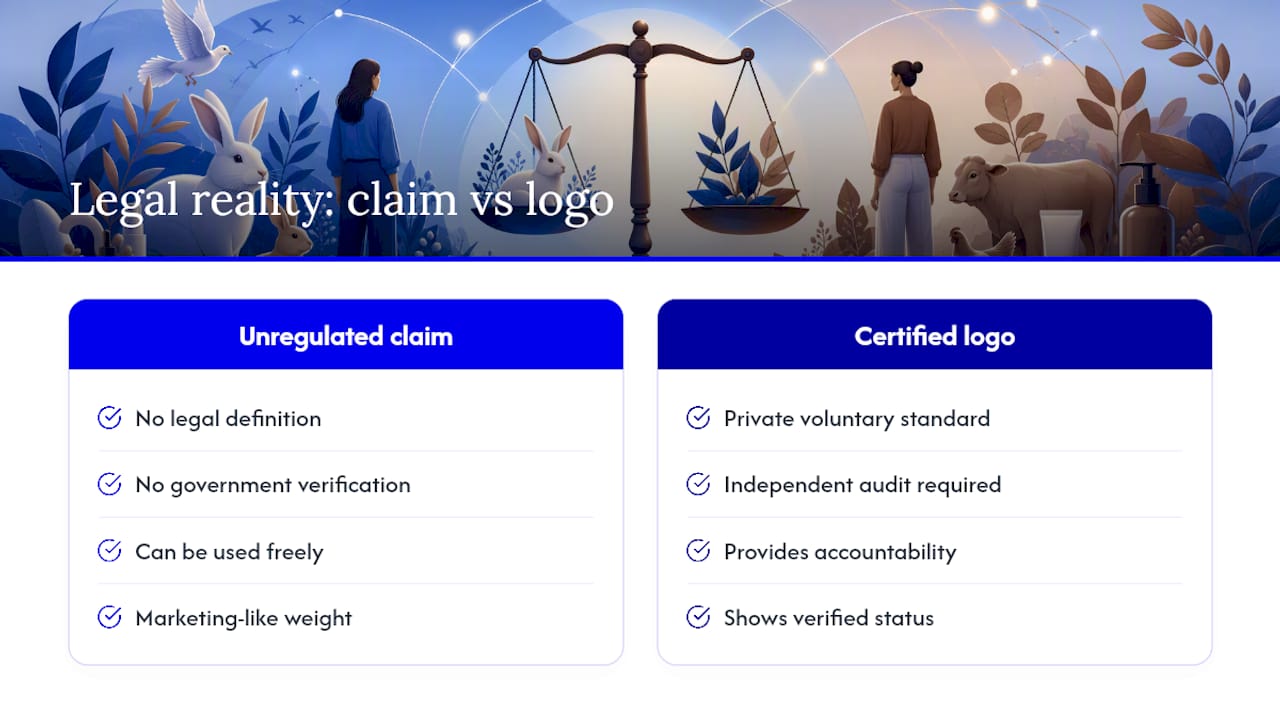
No. Neither term carries a legal definition in the United States, and the FDA has been explicit that it doesn’t regulate cosmetic claims like “cruelty-free” or “not tested on animals.” Any manufacturer can print either phrase on a package with no government review and no penalty for a stretch of the truth.
That regulatory vacuum is exactly why the certification landscape exists in the first place. Leaping Bunny, PETA, and the Vegan Trademark all built private, voluntary standards precisely because no public agency was going to define the terms for them. The upside is real accountability from organizations that specialize in this. The downside is that certification is optional, so plenty of legitimate cruelty-free and vegan products simply never applied for a logo, and plenty of dubious ones use the words freely with nothing behind them.
For you as a shopper, the implication is straightforward: a claim printed on a box carries no more legal weight than a marketing slogan. A logo from an audited program carries actual verification behind it. Those two things look similar in a store aisle and mean very different things. If a brand’s cruelty-free or vegan status matters enough for you to base a purchase on it, the logo (or its absence) is doing more work than the words next to it.
Beyond Testing and Ingredients: The Wider Ethical Picture
Animal testing and animal-derived ingredients get most of the attention, but they’re not the only ethical questions tangled up in a bottle of moisturizer. Palm oil sourcing, a common ingredient base in cosmetics, has driven deforestation debates for years, and a product can be cruelty-free and vegan while still relying on palm derivatives grown on land cleared of rainforest.
Packaging is another blind spot. A cruelty-free, vegan serum sold in layers of plastic and shipped in oversized boxes isn’t advancing much of anything environmentally, even if the formula itself checks every ethical box.
Labor conditions rarely make it onto a label at all. Ingredient sourcing, particularly for botanicals harvested by hand in developing regions, carries its own set of fair-wage and working-condition questions that neither “cruelty-free” nor “vegan” was ever designed to answer. If those issues matter to you as much as the animal-welfare angle, you’re looking for a separate set of claims entirely: Fair Trade certification, B Corp status, or a brand’s own sustainability reporting. None of that shows up automatically just because a product avoided animal testing or animal ingredients.
Where the Cruelty-Free and Vegan Movements Actually Came From
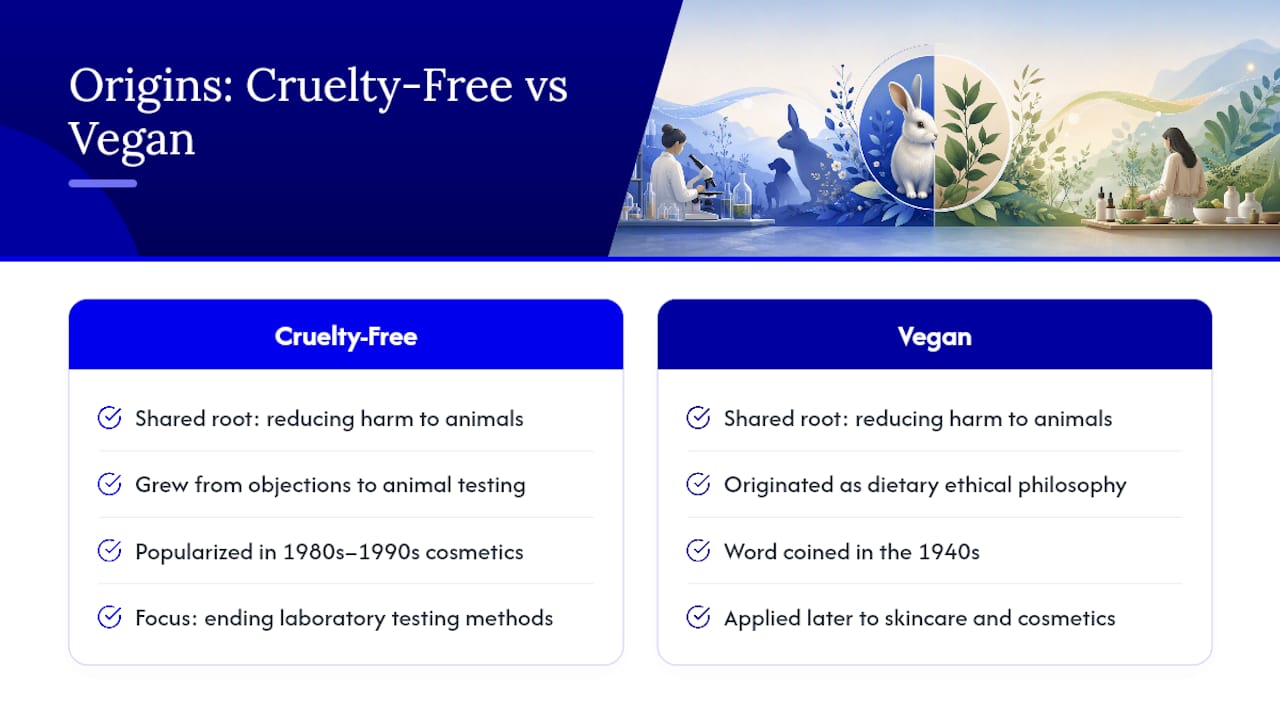
The cruelty-free concept in cosmetics traces back to growing public unease over animal testing methods used through the mid-20th century, particularly tests involving rabbits’ eyes and skin irritation trials. Consumer pressure through the 1980s and 1990s pushed major beauty brands to publicly disavow the practice, which is when “cruelty-free” started appearing on packaging as a selling point rather than an internal policy note.
Veganism as a movement predates cosmetics entirely. It began as a dietary and ethical philosophy focused on eliminating animal exploitation across food, clothing, and eventually personal care. The word itself dates to the 1940s, coined by early advocates who wanted a term distinct from vegetarianism. Its jump into skincare and cosmetics came later, as the same “leave no animal product behind” logic that shaped vegan diets got applied to what people put on their skin.
The two movements share a root concern (reducing harm to animals) but grew from different questions. Cruelty-free grew out of objections to a specific laboratory practice. Veganism grew out of a broader philosophical stance on using animals at all, for anything. That’s the historical reason the labels never fully overlapped, and why treating them as synonyms misses what each one was actually built to address.
How the US and EU Handle Testing and Labeling Differently
Regulatory divergence between major markets creates some of the strangest edge cases in this whole topic. The European Union banned animal testing for cosmetics outright, along with marketing products tested on animals elsewhere, which pushed EU brands toward alternative testing methods well before most of the rest of the world followed.
The United States has no equivalent federal ban. Testing on animals for cosmetics remains legal, even if increasingly rare among major brands, and as already noted, the FDA doesn’t regulate the word “cruelty-free” at all.
China complicates things further. For years, certain imported cosmetics sold in mainland China faced mandatory animal testing requirements regardless of how the product was tested elsewhere, which meant a genuinely cruelty-free brand selling internationally could still trigger animal testing simply by entering that market. Rules have loosened for some product categories, but the requirement hasn’t disappeared entirely, and it’s exactly the kind of supply-chain wrinkle that a fixed-cut-off-date certification can miss if a brand expands into a new market after certification.
The practical takeaway: a “cruelty-free” claim earned in one country doesn’t automatically travel with the product everywhere it’s sold.
Does Choosing Cruelty-Free and Vegan Products Affect Your Skin’s Safety?
Neither label is a proxy for gentler or safer formulation. A product can be cruelty-free and vegan and still contain synthetic fragrance, high concentrations of active acids, or preservatives that trigger sensitivity in some people. Vegan doesn’t mean hypoallergenic, and cruelty-free doesn’t mean dermatologist-tested.
That said, the ingredient-scrutiny habit both labels encourage has a real side benefit. Reading a full panel closely enough to spot carmine or lanolin also means you’re more likely to notice fragrance, alcohol content, or known irritants before they end up on your face. The verification discipline this article recommends for ethical reasons doubles as a decent screening process for skin safety, even though that was never its original purpose.
The Ongoing Disagreements Inside Both Communities
Not everyone in the cruelty-free space agrees on how strict a standard should be. The biggest fault line is self-declared claims versus audited certification. Some consumers and advocacy voices argue that any brand willing to state its policy publicly deserves the benefit of the doubt. Others insist that without supplier audits like Leaping Bunny’s, a “cruelty-free” claim is functionally unverifiable and shouldn’t be trusted at scale.
The vegan cosmetics world has its own recurring argument, mostly around ingredients that are technically animal byproducts but arguably not “exploitation” in the way meat or leather are: beeswax, honey, and lanolin sit in a gray zone where some strict vegans exclude them without exception, while others distinguish between ingredients that require killing an animal and those that don’t.
There’s also friction around parent-company ethics. A small brand can be genuinely cruelty-free and vegan while owned by a conglomerate that tests other product lines on animals elsewhere. Whether that ownership structure should disqualify the smaller brand’s claim is a live debate, not a settled one, and reasonable people land on different sides of it.
Prioritizing Vegan vs. Cruelty-Free: An Editorial Take
If you can only chase one label today, ingredient sourcing tends to matter more day-to-day because it’s the thing actually touching your skin and the environment. Testing policy matters more at the level of corporate accountability. The honest goal is both, and Splendoraskincare’s catalog shows that’s achievable without complexity or inflated pricing. Where you have to compromise, compromise on brand size before you compromise on transparency. A smaller company that answers your ingredient questions directly beats a bigger one that hides behind vague marketing.
— Cyril
Shop Splendoraskincare’s Cruelty-Free, Vegan Lineup
Splendoraskincare exists as the direct alternative to hunting through unregulated label claims one brand at a time: every product page lists full ingredients up front, so you check the formula yourself instead of trusting a logo you can’t verify.

If you want to skip the ingredient-by-ingredient audit this article just walked you through, start with the SKINCARE 5-STEP ROUTINE, a cleanser-to-moisturizer bundle built specifically for shoppers who want a complete regimen without stacking five separate brand policies. For targeted concerns, the Skincare Anti-Aging Anti-Wrinkle Whitening Facial Serum addresses fine lines and tone in one step, and the Collagen Sunscreen covers daily UV protection with the same ingredient transparency as the rest of the line. Every one of these pages spells out sourcing details, so you can confirm the vegan and cruelty-free status yourself rather than taking a marketing claim at face value. Browse the full catalog and check any product’s ingredient panel before checkout.
Where to Verify Claims Yourself
- Leaping Bunny — audited cruelty-free registry
- PETA Approved Vegan — vegan product directory
- Vegan — ingredient and testing verification
- FDA cosmetics labeling guidance — regulatory background
Sources
- FDA — Cosmetics labeling claims: cruelty-free/not tested on animals
- Leaping Bunny — About / Corporate standard
- Vegan
- Humane World for Animals — Consumer guide to cruelty-free
FAQ
Does “not tested on animals” mean a product is vegan?
No. “Not tested on animals” only addresses testing practices; the product can still contain animal-derived ingredients like beeswax, carmine, or lanolin.
Does “cruelty-free” actually mean anything, legally?
Not in a regulated sense. The FDA doesn’t define or enforce the term, so its reliability depends entirely on whether a brand backs it with third-party certification like Leaping Bunny.
Is PETA’s cruelty-free list the same as its vegan list?
No. PETA runs two separate resources: a cruelty-free company database based on testing policy, and a “PETA Approved Vegan” directory focused on ingredient composition, and a product can appear on one without qualifying for the other.
Can a product be cruelty-free but not vegan?
Yes, and it’s common. A moisturizer with honey or beeswax can pass every cruelty-free standard while still failing a vegan ingredient check.
Does Splendoraskincare verify its own cruelty-free and vegan claims?
The brand states an emphasis on clean, vegan ingredients and cruelty-free practices and provides ingredient details on product pages for customer review.