

How to Tell if Skincare Is Actually Cruelty-Free
A product is genuinely cruelty-free when the finished formula, every ingredient in it, and every supplier behind it are free from animal testing, verified by someone other than the brand itself. That last part is the whole game. Anyone can print “cruelty-free” on a bottle. The claim only means something once a third party checks it.
Here’s what to do in the next five minutes if you’re standing in front of a product right now:
- Look for a certifier logo (Leaping Bunny, Cruelty Free International, or PETA’s bunny) and confirm the brand on the certifier’s own public list, not just the packaging.
- No logo? Check the brand’s website for a published, fixed cut-off date and a stated supplier-monitoring policy.
- Still nothing? Treat “cruelty-free” as marketing copy until proven otherwise.
Pro Tip: Bookmark the certifier databases instead of trusting a logo photo. Packaging art doesn’t get revoked when a brand fails an audit, but a certifier’s public list does.
Key Takeaways
A cruelty-free claim only means what it says once a third-party certifier with a fixed cut-off date and supplier audits has verified it.
| Point | Details |
|---|---|
| Verify, don’t trust the logo | Check the brand name against the certifier’s own public list, not just the printed logo. |
| Cruelty-free and vegan are different | Cruelty-free covers testing methods; vegan covers ingredient sourcing, and some shoppers need both. |
| Certifier scope varies | Some programs cover the whole parent company; others approve individual brands only, so check which applies. |
| Cut-off dates matter more than laws | A brand’s own published cut-off date and supplier-monitoring policy often say more than local testing bans do. |
| Splendoraskincare builds in the standard | Its cruelty-free, vegan, gluten-free routine, including the 5-Step Routine bundle, is designed to skip the guesswork. |
Table of Contents
- What Cruelty-Free Skincare Actually Means
- Certifications and Logos You Can Trust
- How Do You Verify a Cruelty-Free Claim Before Buying?
- Shopping Smart: What to Watch on Labels and Product Pages
- Recent Legal Changes Are Reshaping Animal Testing Policy
- Supporting Cruelty-Free Brands Beyond the Purchase
- Reporting Misleading or Non-Compliant Cruelty-Free Claims
- Where Splendoraskincare Stands on Cruelty-Free Standards
- A Simple Cruelty-Free Routine, Verified and Ready
- Frequently Asked Questions
- Sources
What Cruelty-Free Skincare Actually Means
Cruelty-free means no animal testing happened at any stage: not on the finished product, and not on the individual ingredients that went into it. That second part trips up a lot of shoppers. A brand can honestly say it never tested a single one of its own products on animals while still buying raw ingredients from a supplier who did the testing upstream. Real cruelty-free certification closes that loophole by examining the whole supply chain, not just the brand’s own lab.
Vegan is a different standard entirely, and mixing the two up is the most common mistake in this space. Cruelty-free is about testing methods. Vegan is about ingredients. A product can be cruelty-free and still contain beeswax, lanolin, or collagen sourced from animals. Conversely, a fully plant-based formula could theoretically still have been tested on animals somewhere in its development, though that’s rare among brands that bother going vegan in the first place. The Vegan Society requires both no animal testing and no animal-derived ingredients, which is why its trademark is the stricter of the two claims.
A few things worth keeping straight:
- “Cruelty-free” addresses testing methods only.
- “Vegan” addresses ingredient sourcing only.
- A shopper who wants both needs to see both certifications, not one used as a stand-in for the other.
Regional bans complicate things further. Some countries prohibit cosmetics animal testing by law, which means every brand selling there is technically compliant whether or not it says so. That’s exactly why independent certification still matters: it verifies practices that go beyond whatever the local law happens to require.
Certifications and Logos You Can Trust
Not all cruelty-free logos carry the same weight, and the differences come down to how rigorously each program checks its claims.
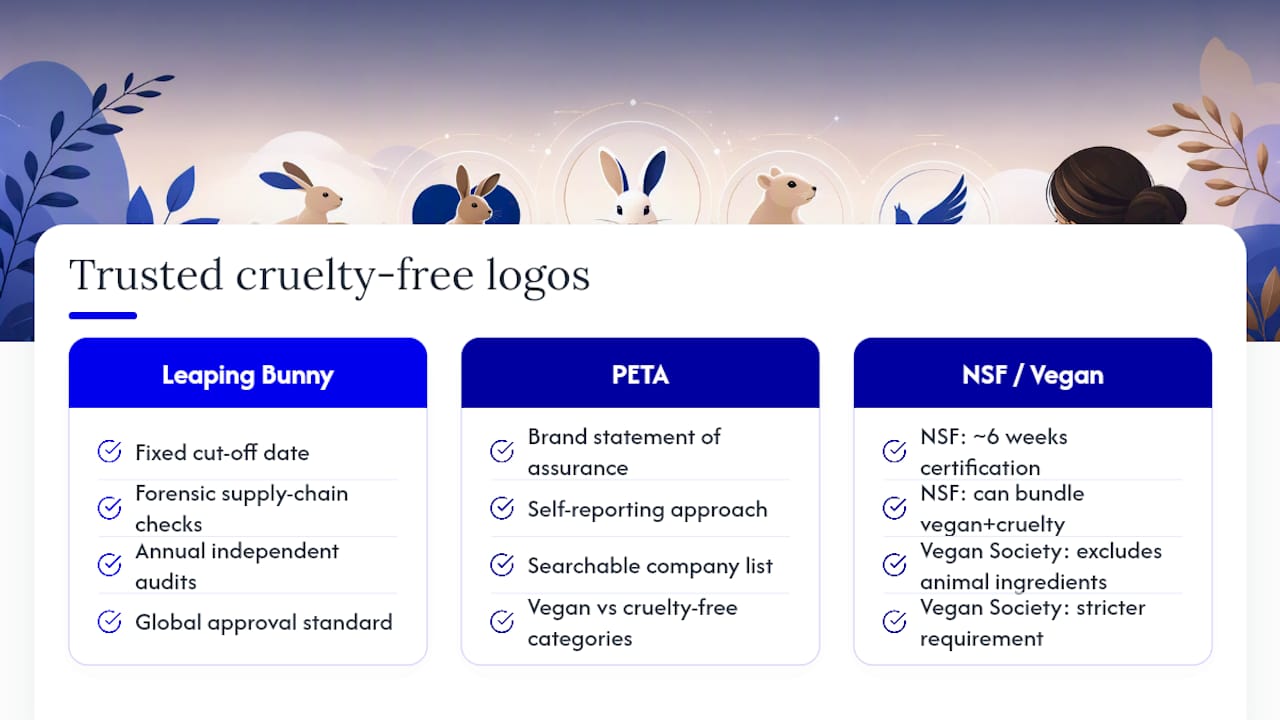
Cruelty Free International’s Approval Programme, which operates the Leaping Bunny logo in several markets, requires a fixed cut-off date, forensic examination of supply chains, and annual independent audits. Its approval standard applies globally and goes well beyond regional legal bans on animal testing. Leaping Bunny’s own Corporate Standard works the same way: companies can’t conduct, commission, or purchase ingredients tested on animals after their declared cut-off date, and suppliers have to comply too. Leaping Bunny keeps a public brand list you can search directly.
PETA’s Beauty Without Bunnies program takes a self-reporting approach: brands sign a statement of assurance and appear on a searchable company list, split between fully vegan and cruelty-free-but-not-vegan categories. It’s less audit-heavy than Leaping Bunny or Cruelty Free International, but the searchable list is genuinely useful for a quick check.
NSF and The Vegan Society sit at different ends of a related spectrum. NSF’s cruelty-free certification is comparatively fast, taking approximately six weeks, and can be bundled with vegan certification in a single process. The Vegan Society requires exclusion of animal-derived ingredients on top of no animal testing, making it the stricter option for anyone who wants both boxes checked.
The practical wrinkle across all of them: scope varies. Ethical Consumer’s certifier comparison points out that some programs certify the whole corporate family, while others approve individual brands only, even when the parent company tests elsewhere. That distinction changes how much a logo on one product line actually tells you about the company behind it.
How Do You Verify a Cruelty-Free Claim Before Buying?
Run through these five checks, in order, before you trust a claim:
- Find the certifier logo and confirm it independently. Search the brand name on Leaping Bunny’s, Cruelty Free International’s, or PETA’s public list rather than trusting the printed logo alone.
- Look for a fixed cut-off date and supplier-monitoring policy. Brands serious about the claim publish this on an “our commitment” or FAQ page, usually with specific language about supplier compliance.
- Check the parent company’s policy, not just the brand’s. A cruelty-free brand owned by a company that tests other product lines on animals is a real gray area, and Ethical Consumer’s scope comparison is worth reviewing when a favorite brand belongs to a larger conglomerate.
- Look for a third-party audit statement. Language like “annually audited” or “independently verified” signals more than a self-reported pledge.
- Ask the brand directly if anything’s unclear. A brand with nothing to hide will answer specific questions about its cut-off date and supplier policy without deflecting.
Pro Tip: If a brand’s customer service dodges a direct question about its cut-off date, that dodge is itself information. Legitimate cruelty-free brands know this date cold because it’s the backbone of their certification.
The FDA is blunt about this: “cruelty-free” and “not tested on animals” are marketing claims with no legal definition in the United States. That’s not a knock on honest brands. It’s the reason third-party verification exists in the first place, and why skipping it means taking a company’s word for something it has every incentive to overstate.
Shopping Smart: What to Watch on Labels and Product Pages
Product pages move fast, and claims can be worded to sound stronger than they are. A quick scan pays off before checkout.
- Read past the front-of-package logo to the brand’s “our ingredients” or “our commitments” page, where the real policy details usually live.
- If an ingredient’s supplier has a history of animal testing on that raw material, look for a brand statement addressing supplier-level sourcing specifically, not just its own testing practices.
- Decide upfront whether you need cruelty-free alone or cruelty-free plus vegan. If you want both, look for both certifications rather than assuming one implies the other.
- Be skeptical of retailer “cruelty-free” filter categories. Many are compiled from brand self-declarations submitted to the retailer, not from independent certifier lists, so a filtered result still needs a follow-up check.
None of this takes more than a couple of minutes once you know where to look, and it beats finding out after the fact that a “cruelty-free” filter meant nothing more than a checkbox a brand ticked on a supplier form.
Recent Legal Changes Are Reshaping Animal Testing Policy
Animal testing law for cosmetics is shifting unevenly across the world, and that unevenness is exactly why certification still matters more than geography. Some markets have banned cosmetic animal testing outright, others restrict it only for finished products while still permitting ingredient-level testing, and others have no restriction at all. A brand can be fully legal in every market it sells in while still relying on animal-tested raw materials sourced from a country with no such ban.
This patchwork is precisely the gap Cruelty Free International’s Approval Programme was built to close. Its standard applies globally and holds every certified brand to the same cut-off date and supply-chain requirements, regardless of what local law does or doesn’t require. That consistency matters for shoppers buying internationally or through online retailers that ship worldwide, where “legal in this market” and “certified cruelty-free” are two very different claims.
The trend line is toward more third-party verification, not less. As more markets adopt some form of testing restriction, brands increasingly lean on independent certification to prove standards that outlast whatever a given country’s law currently requires. For shoppers, the takeaway stays the same regardless of where a law changes next: certification, not legal compliance, is the signal to check.
Supporting Cruelty-Free Brands Beyond the Purchase
Buying certified products moves the needle, but it’s not the only lever available to you. Advocacy compounds the effect of every purchase you already make.
Leaving honest reviews that mention certification specifically helps other shoppers skip the guesswork you just went through. Following and sharing certifier organizations’ public brand-list updates keeps that information circulating past the people who already know to look for it. If a favorite brand hasn’t pursued certification yet, a direct message asking why is a low-effort nudge that adds up when enough customers send it.
Retailers also respond to demand signals. Asking a store, physical or online, to expand its certified cruelty-free selection is a small action that shapes what shows up on shelves and search filters for everyone after you. And staying current on regulatory shifts in animal testing law, even loosely, means you’ll recognize when a “compliant” claim is doing less work than it sounds like it’s doing.
None of this requires activism in the formal sense. It’s closer to being a slightly more vocal version of the shopper you already are.
Reporting Misleading or Non-Compliant Cruelty-Free Claims
If you spot a claim that doesn’t hold up, the certifiers themselves are the right first stop. Leaping Bunny, Cruelty Free International, and PETA all maintain contact channels specifically for reporting suspected misuse of their logos or false certification claims, and they take unauthorized logo use seriously since it undermines the credibility of every brand that earned certification legitimately.
In the United States, the FDA accepts consumer complaints about misleading cosmetic labeling claims, including unsubstantiated cruelty-free statements, through its consumer complaint system. That’s the appropriate channel when a domestic claim looks deceptive rather than simply vague.
Retailers deserve a message too. If a store’s “cruelty-free” filter includes a brand that isn’t on any certifier’s public list, flagging it directly to the retailer’s customer service can prompt a review of how that category gets compiled. It won’t fix the problem overnight, but retailer categories change when enough customers point out the gap between what’s labeled and what’s actually verified.
Where Splendoraskincare Stands on Cruelty-Free Standards
Splendoraskincare builds every formula around a simple commitment: clean, vegan, gluten-free ingredients with no animal testing anywhere in the process, sourced through hand-harvested materials chosen for both effectiveness and sustainability. That combination, cruelty-free plus vegan, is the stricter standard this guide keeps pointing shoppers toward, and it’s the default here rather than an upsell.
The lineup reflects that standard across the concerns shoppers ask about most: a Collagen Anti-wrinkle Hydrating Skin Moisturizing Lotion and a fading-wrinkle eye mask for visible aging, a smooth skin serum and an organic skin tag removal serum for texture concerns, a gentle facial moisturizing lotion for sensitive skin, a whitening anti-aging facial serum, and a collagen sunscreen for daily protection. Shoppers who want the checklist from earlier already applied for them can start with the 5-step routine bundle, which covers cleanser through moisturizer in one set.
A Simple Cruelty-Free Routine, Verified and Ready
There are other ways to piece together a cruelty-free routine: hunting down individual certified products across a dozen different brands, cross-checking each one against a certifier list, and hoping the combination actually works well together on your skin. That works, but it’s a lot of homework for five products.

Splendoraskincare’s 5-Step Routine skips that homework by bundling a cleanser, toner, serum, eye cream, and moisturizer into one cruelty-free, vegan, gluten-free set, so you’re not verifying five separate supply chains one at a time. Every formula uses clean, hand-harvested ingredients with no animal testing at any stage, and the brand’s sourcing and sustainability commitments are laid out directly on the Splendora site for anyone who wants to check the details themselves before buying. If anti-aging is the priority, the Collagen Anti-wrinkle Hydrating Skin Moisturizing Lotion and the Collagen Sunscreen pair well as daily additions to that same routine.
Start with the 5-step set if you want the full routine solved in one order, or add the anti-aging duo to whatever you’re already using.
Frequently Asked Questions
What does “cruelty-free” actually mean on a skincare label? It means no animal testing occurred on the finished product or on any individual ingredient, at any point in the supply chain. Since the term itself isn’t legally regulated in most markets, the FDA advises relying on third-party certification rather than the label alone.
What is the Leaping Bunny meaning behind that logo? Leaping Bunny is a certification standard requiring a fixed cut-off date after which no animal testing can occur anywhere in a brand’s supply chain, backed by supplier compliance monitoring and a searchable public brand list.
Is cruelty-free skincare the same as vegan skincare products? No. Cruelty-free addresses testing methods, while vegan addresses ingredient sourcing. A product can be cruelty-free without being vegan if it contains animal-derived ingredients like beeswax or collagen, so check for both labels if both matter to you.
How do I build a cruelty free skincare routine from scratch? Start with certified basics: a cleanser, a moisturizer, and one targeted treatment like a serum, all checked against a certifier’s public list. Bundled options, like a 5-step routine set, remove the need to verify each product separately.
Are all “not tested on animals” claims reliable? Not automatically. That exact phrase is a marketing claim with no independent verification behind it unless the brand also carries third-party certification, which is why checking the certifier’s own list matters more than the wording on the bottle.
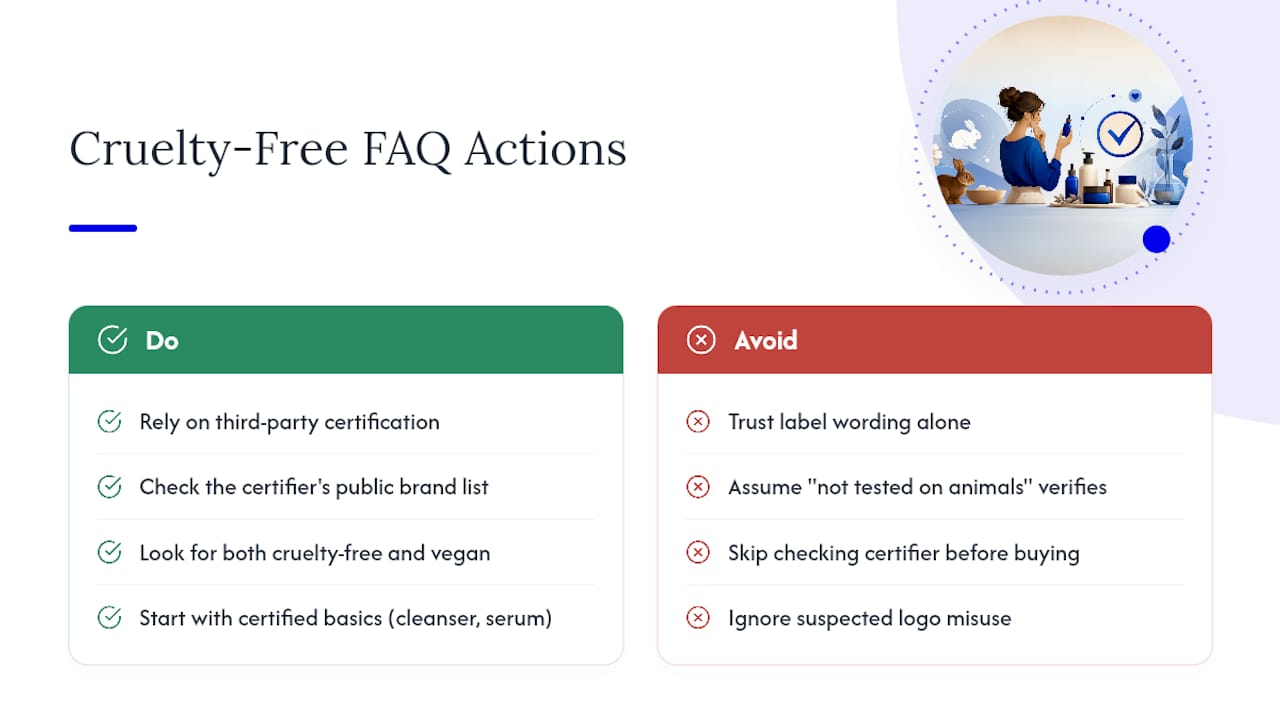
What should I do if I suspect a brand is misusing a cruelty-free logo? Report it directly to the certifier whose logo is in question, Leaping Bunny, Cruelty Free International, or PETA, since all three investigate unauthorized or misleading use of their marks.
Sources
- Cruelty Free International Approval Programme (briefing note)
- The Corporate Standard of Compassion For Animals (Leaping Bunny)
- NSF Cruelty-Free Certification | NSF
- A guide to cruelty-free and animal testing certifications | Ethical Consumer
- FDA — cruelty-free / not tested on animals
Recommended
- The Secret to Naturally Glowing Skin: Your Complete Skincare Guide – Splendora
- SKINCARE 5-STEP ROUTINE CLEANSER - TONER - SERUM -EYE CREAM - MOISTURI – Splendora
- Skincare Anti-Aging Anti-Wrinkle Whitening Facial Serum – Splendora
- Deep Cleansing Makeup Remover Hydrating And Skin Rejuvenating Foam Fac – Splendora